Politecnico di Torino logo

Strategy implementation and monitoring

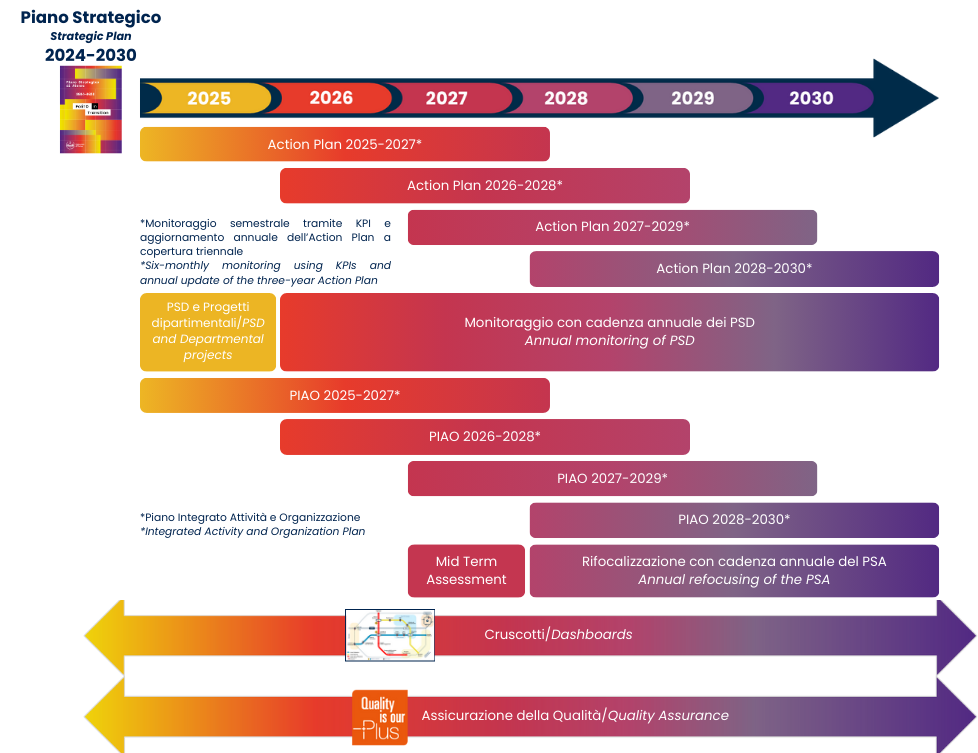
The Politecnico di Torino has worked to create close integration between strategic planning and quality assurance activities.  The University Strategic Plan (in Italian Piano Strategico di Ateneo, PSA)  forms the basis for all planning and subsequent monitoring activities. The integrated planning and monitoring process is implemented through the “Strategic Planning and Review Model - University and Departments” (in italian “Modello di pianificazione strategica e Riesame – Ateneo e Dipartimenti), a document drafted with the contribution of the PQA and approved by the Governing Bodies at their meetings in October 2024.
Schema Strategia A4 ita-eng
  • Strategic Plan (in italian Piano Strategico di Ateneo - PSA): The Plan has been drawn up on the basis of the three major transitions affecting our society - digital, ecological and socio-cultural - and in which Politecnico intends to play a leading role. These are the transitions that permeate all the activities of a University that will focus on three major objectives in the coming years:
    • to position itself firmly among the best European and international technological universities;
    • to strengthen its role as a driver of competitiveness within the local ecosystem;
    • to become attractive, recognisable and recognised by enhancing the value of its distinctive features.
  • Action Plan of PSA: document for planning, monitoring, and evaluating strategic objectives, drawn up on a three-year basis, with annual updates.
  • Action Plan monitoring: monitoring the implementation of milestones for each area of intervention included in the Action Plan and the degree to which performance objectives have been achieved with a view to integration into the Integrated Activity and Organization Plan (PIAO).
  • Departmental Strategic Plans (in italian Piani Strategici Dipartimentali - PSD): documents containing the vision and mission of each Department, as well as strategic guidelines and related objectives. The PSD are developed over a time frame coinciding with the PSA, with the possibility of updates at the beginning of the new term of office of the Department Director.
  • Departmental projects: projects linked, in whole or in part, to the PSD, which form the basis for the allocation of a portion of resources. These departmental projects include appropriate indicators, defined in agreement with the University, to be used to assess the achievement of project objectives.
  • PSD monitoring: The implementation of the PSD is monitored annually, including through the use of indicators provided by the University, for the purposes of self-assessment of departmental actions and to support the review of strategic objectives.
  • Integrated Activity and Organization Plan (in italian Piano Integrato di Attività e Organizzazione - PIAO): the tool for “ensuring the quality and transparency of administrative activities and improving the quality of services to citizens and businesses, as well as proceeding with the constant and progressive simplification and reengineering of processes, including those relating to the right of access.” The PIAO contextualises, accommodates and helps to harmonise numerous thematic plans with different levels of integration depending on their nature and life cycle.
  • Mid Term Assessment of PSA: document analyzing the evolution of strategic planning following the assessment of the degree to which the PSA objectives were achieved, conducted halfway through the rector's term of office.

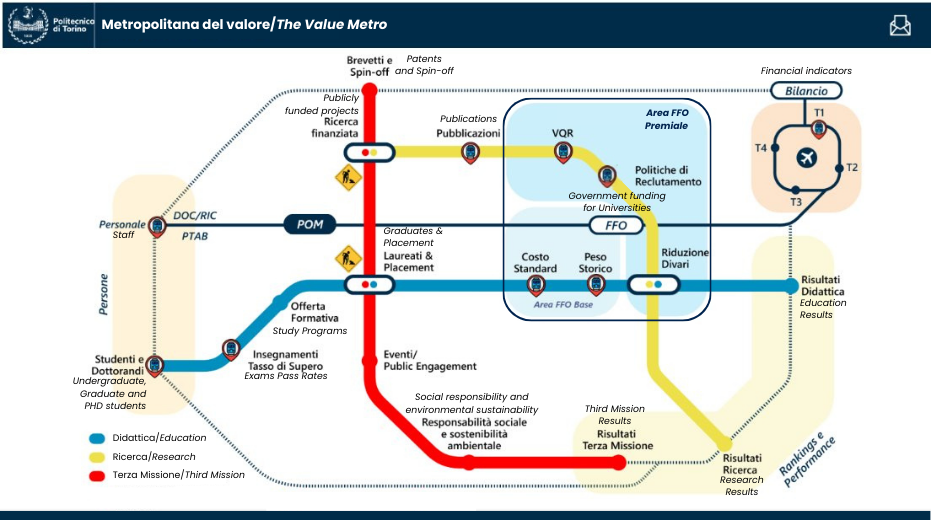
The governing bodies and actors involved in strategic planning processes, both at the university and departmental levels (PSA and PSD), have access to dedicated dashboards for monitoring purposes. The dashboards are organized into an integrated system called “The Value Metro,” a graphic representation that interprets the intersections between the various monitoring dashboards of the main areas related to the University's three Missions through the lines of Teaching, Research, and Knowledge Enhancement (Third Mission/Social Impact). The “metro” represents the entry point to the dashboard system, which can be accessed with different levels of profiling. The dashboards are developed by the PoliTO Strategies Study Center (formerly CentroStudi4IMPACT@POLITO) and the STARQ Area (formerly PROSIQ Division) to support the definition, implementation, and monitoring of strategic planning activities.


Metro del valore ita-eng

The publications dashboard is a tool designed to allow professors and researchers at the Politecnico di Torino to see their position within the Italian university system. This innovative tool allows users to analyze phenomena related to scientific production through benchmarking with the national system and to promote a culture of self-assessment and informed use of bibliometric indicators.

The dashboards for students and doctoral students are divided into:

  • Student Population/Student Data Dashboard (TEACHING): it responds to the most frequent requests for data, mainly from College Coordinators. It is divided into several dynamic sections that can be filtered:
    • Time series;
    • Registered students;
    • Enrolled students;
    • Graduated students;
    • Student results;
    • INTE Focus - Results of foreign students.
  • Study Course Attractiveness Dashboard: It allows benchmarking (ANVUR data) on the attractiveness of our  Bachelor's and Master's degree programs compared to other Italian universities, based on certain metrics:
    • Career starters;
    • Pure enrolled students;
    • Registered students;
    • Graduated students;
  • PhD dashboard: it aims to provide an initial overview of trends and is divided into several dynamic sections that can be filtered:
    • Time series;
    • Registered students;
    • Career starters;
    • Research doctors;
    • Mobility;
    • Publications.

The “Pass Rates” dashboard allows to analyze pass rates and average time taken to pass exams at different levels: Vice-Rector, Collegi Coordinators, Study Program Coordinators, and individual professors.

It provides data, information, and analysis useful for adopting policies/actions aimed at improving graduation times.

The “Staff” dashboard allows analysis of the composition of teaching and research staff and technical, administrative, and library staff according to certain criteria, including: role, location, scientific discipline, gender, and age.

The FFO Area dashboards provide an overview of ministerial allocations relating to the Government funding for universities (in italian Fondo di Finanziamento Ordinario - FFO), also allowing for benchmark analysis of individual components within the Italian university system.

The POM dashboard allows to analyze the allocation of ministerial resources allocated to the staff (POM), providing insight into the complex calculation algorithm underlying the allocation. 

Archive

The strategic planning and monitoring activities from previous years are available below:
Schema attuazione della strategia e monitoraggio
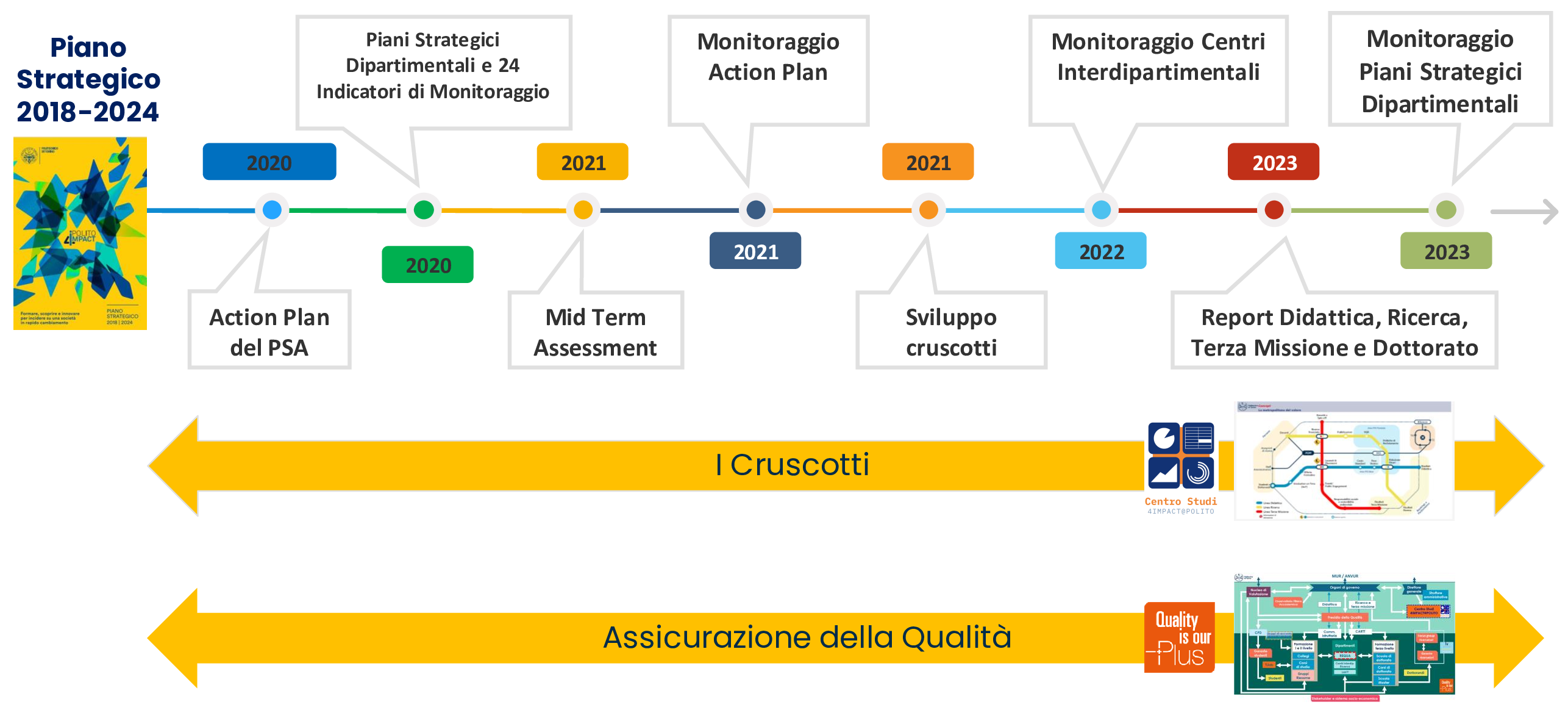
  • Strategic Plan (in italian Piano Strategico di Ateneo - PSA): the document reflects the vision, mission, strategic directions of the current rector’s mandate, outlining specific objectives related to the Missions (Teaching, Research, Third Mission) and Quality;
  • PSA Action Plan: a document for planning, monitoring and evaluating strategic objectives, drawn up on a three-year, annually rolling basis; 
  • Departmental Strategic Plans: documents containing the vision and mission of each department as well as the strategic lines and related objectives; 
  • The 24 Monitoring Indicators: a system for monitoring and recognising the contribution of the Departments to the implementation of the University's strategies. There are 24 indicators (3 for each of the 8 strategic areas of the PSA) which are periodically monitored and commented on by the Departments;
  • Mid Term Assessment: this document analyses the evolution of strategic planning after the review of the degree of achievement of the PSA objectives, conducted at the mid-term of the rector's term;
  • Action Plan monitoring: monitoring the implementation of the actions and projects envisaged in the Action Plan and the degree of achievement of the performance objectives with a view to integration into the PIAO-2023-2025 Integrated Business and Organisation Plan (in Italian Piano Integrato di Attività e Organizzazione, PIAO);
  • Monitoring of Interdepartmental Centres: periodic monitoring of the results of the Interdepartmental Centres and subsequent evaluation by the Evaluation Board, with the aim of highlighting critical issues and possible corrective actions in light of their reconfirmation;
  • Teaching, Research, Third Mission and PhD Report: self-evaluation documents reporting on the results achieved, the strengths and weaknesses found and the improvement actions planned in these areas;
  • Monitoring of Departmental Strategic Plans: the documents analyse the development of downstream strategic planning and the objective levels reached;
  • Dashboards: integrated dashboard system developed by PoliTO Strategies Study Center (formerly CentroStudi4IMPACT@POLITO) and by PROSIQ Division (formerly PEPS) to support the definition, implementation and monitoring activities of the Strategic Planning.