Teaching methods
The educational and training programme implements an innovative and highly experiential approach. The learning and teaching activities will follow novel educational approaches specifically developed and tested in university context. Specifically, students will have the opportunity to:
- Listen to a keynote speech from an international expert in this specific sector. This keynote, placed right at the beginning of the programme, is intended to stimulate the critical thinking of the participants, opening questions rather than providing them with solutions. This approach shall open students’ eyes on major perspectives and challenges of the application of Artificial Intelligence in the Aerospace domain. Some of the challenges will then be tackled in the lectures modules as well as in the associated training sessions.
- Learn new content on specific subjects by attending the lectures modules. Thanks to the experience of the professors involved in the programme, these modules will implement innovative teaching techniques, that depending on the specific discipline may include flipped classroom, gamification, or role play. These approaches will guarantee a higher audience engagement as well as more satisfactory and long-lasting learning outcomes.
- Practice on each specific discipline, soon after the theoretical sessions. The students will experience teamwork and will be challenged to think out-of-the-box to develop innovative butfeasible solutions for specifically tailored challenges that will be suggested by the industrial stakeholders. During this session they will also develop public speaking and as well as synthesis skills.
- Actively participate in co-designing future educational measures by attending the conclusive workshop. This final event entitled “Future generation of experts in Aerospace innovations driven by Artificial Intelligence: let’s design together a novel educational paradigm” will be articulated in three parts of about 30 min each.
- The first part, “Student Voice”, will be organized in round tables (5 students, 1 academic expert, 1 industrial expert) where students will have to do brainstorming and prioritize the three major educational needs in this context. Non-students can only listen. This approach is expected to flip the power dynamic immediately.
- The second part, “Experts Reflection”, keeping the same round-table formats, experts from academia and industry will try to reflect on the topics highlighted by the students.
- Eventually, each table will run a co-design sprint suggesting a prototype educational activity in the form of a canvas.
In the last 30 min of the workshop, each participant will have the possibility to move around the lecture room, read the other canvas and provide feedback.
Online teaching activities
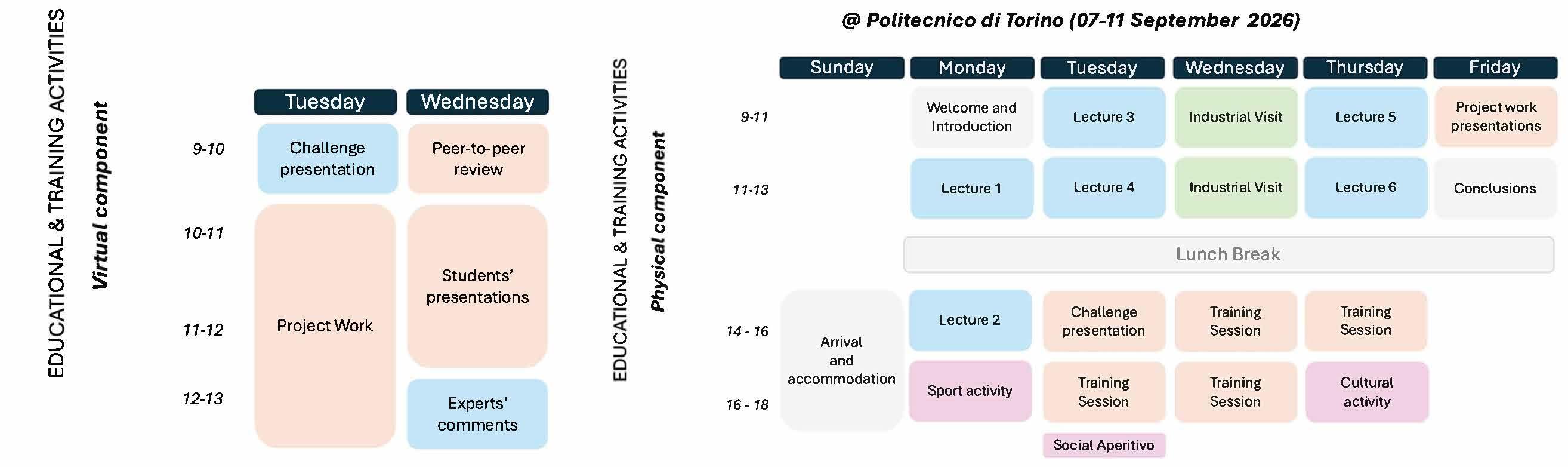
The Virtual component will give the students the possibility to self-discover the importance of AI in the aerospace sector, through a challenge-based learning approach, followed by a peer-to-peer review process. The students will be grouped into 5 teams and tutored by a researcher. Thanks to the material provided during the challenge presentation, each team will be asked to solve a specific aerospace challenge by suggesting the use of Artificial Intelligence. These solutions will be, at first, revised by members of the other teams and eventually by experts.
This virtual component will be organized as follows:
Day 1
- 1 hour challenge presentation and students teams formation and tutor assignment
- 3 hours project work
Day 2
- 1 hour peer review
- 2 hours presentation with feedback from peer and experts
- 1 hour comments
In-presence teaching activities (5 days)
The educational and training programme implements an innovative and highly experiential approach that aims at combining, for the first time, aerospace engineering disciplines with the development and application of Artificial Intelligence. In particular, the 16 hours of lectures divided into 2-hours modules. Each module is co-taught by one academic/industrial international expert in a core aerospace discipline and one academic/industrial international expert in AI/ML.
The content of the 16 hours of the course will follow the following scheme:
- Welcome and introductory keynote speech (2 hours) and introductory keynote speech by an academic/industrial expert on the topic “Perspectives and challenges of AI integration in the Aerospace Domain”
- Module 1 (2 hours) : AI/ML to support Computational Fluid Dynamics
- Module 2 (2 hours): How AI can help aerospace transportation systems reducing its environmental footprint?
- Module 3 (2 hours): AI to design and monitor the aerospace structures
- Module 4 (2 hours): Increased air and space flight autonomy: which role for AI?
- Module 5 (2 hours): AI to help discovering hidden physics behind systems integration
- Module 6 (2 hours): Future planetary habitat: the last frontier of AI – human interface
- Final Workshop (2 hours): “Future generation of experts in Aerospace innovations driven by Artificial Intelligence: let’s design together a novel educational paradigm”. The goal of the workshop is to let academicians listen to students and industrial experts on specific competences required for future engineers to work in an aerospace sector heavily permeated by Artificial Intelligence and to co-design future educational activities in the sector.
- 12 hours of training sessions where the students are split into 4 to 5 groups and they will have to solve a specific challenge suggested by the industrial stakeholders and related to one of the topics dealt with in the theoretical lecture. Each session will be tutored by the academic and industrial experts.
- 4 hours of technical visits to industrial facilities of the Turin ecosystem.
Extracurricular Activities
To foster students’ socialization and to let them experience a “healthy and sporty campus life”, the Summer School will organize the following extracurricular activities:
- 4 hours sport activities in collaboration with CUS
- Social dinner to taste and enjoy the flavours of the Piedmont region that will host them (about 4 hours)
- Moreover, thanks to a visit to the Lingotto Pista 500, the students will have the opportunity to discover the industrial roots of the city of Turin as well as its present and imagine its future. The visit will be closed by an Aperitivo served on the roof of the Lingotto building, to enjoy the beauty of the skyline and as well as to foster socialization once more.