


PhD Days in Energetica 2025: research, interdisciplinary dialogue and artificial intelligence for the energy transition

An opportunity for scientific discussion, networking and in-depth analysis of advanced energy research topics, as well as of opportunities for international collaboration and interaction with industry: on 3 and 4 December 2025 the PhD Days in Energetica took place, two days dedicated to PhD candidates of the 38th, 39th and 40th cycles of the PhD programme in Energetica, offered by the Department of Energy “Galileo Ferraris”-DENERG.
From the neutron to the engine, from urban agglomerations to the biosphere, the PhD programme in Energetica is characterised by the breadth and diversity of research activities spanning the entire spectrum of the energy sector. In this context, the PhD Days represent a key moment of encounter and exchange, during which the different scientific areas of Energetica come together to discuss approaches and results, share scientific and technological methods and tools, and foster an effective process of interdisciplinary cross-fertilisation.
The first day, held in the Aula Magna, opened with an address by the Coordinator of the PhD programme, professor Massimo Santarelli. This was followed by presentations by the PhD students, who showcased the progress and results of their research activities carried out during the past academic year. Presentations by students in the ongoing cycles were organised according to the PechaKucha format, consisting of twenty slides displayed for twenty seconds each, promoting concise, effective and dynamic communication. PhD candidates from the final 38th cycle instead adopted a harmonised, Scientific Area-based approach, with a presentation style inspired by TED Talks.
The presentations covered four main thematic areas, including building physics and energy systems for future buildings and communities, industrial energy systems, technologies and materials for the energy transition, sustainable nuclear energy, and sustainable propulsion and advanced energy systems. Each area was coordinated by a Scientific Area Moderator, whose role was to stimulate discussion and debate and encourage the exchange of questions and viewpoints among participants. Moderation was carried out by professors David Chiaramonti and Massimo Zucchetti during the morning session, and by professors Vittorio Verda and Alfonso Capozzoli in the afternoon.

At the conclusion of the on-stage presentations, the PhD Board voted for the best presentations in each thematic area, which will be awarded on 19 December. For the 40th cycle, the awardees were Giuseppina Arcamone, Timon Benz, Eleonora Agus Poletti and Alessandro Doglione, while for the 39th cycle the winners were Martina Maggiulli, Andrea Moranti, Danilo Caterino and Carmelo Baronetto.
In addition, all research results presented by the PhD students, as well as the involvement of industrial partners, are summarised in the booklet “Annuario 2025”, available on the Energetica PhD Programme webpage.
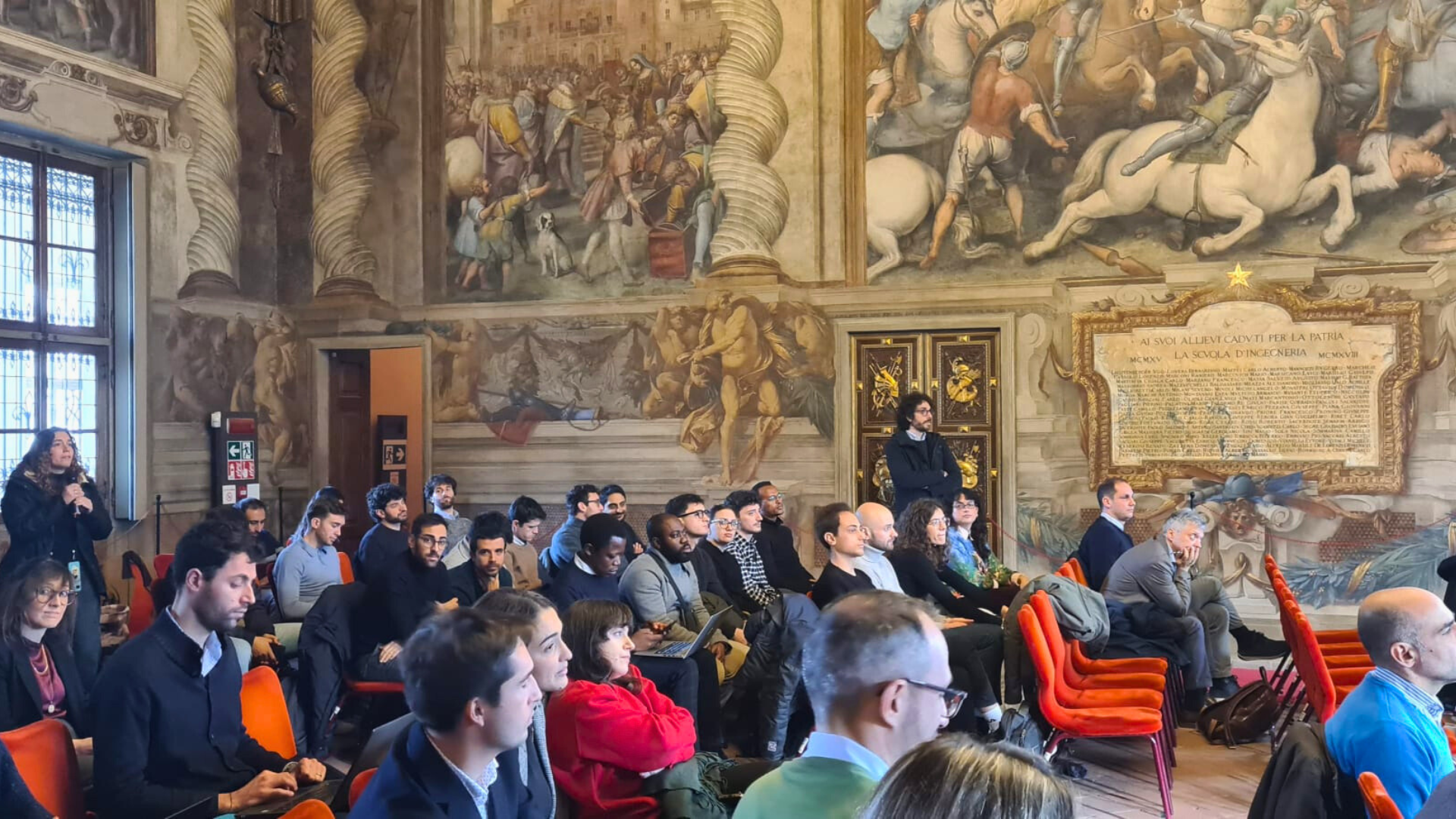
The second day, hosted in the Hall of Honour of the Valentino Castle, was dedicated to the workshop entitled “Energy in the age of AI: modeling materials and systems for a sustainable transition”, focusing on the application of generative artificial intelligence in the energy sector. During the morning session, internationally recognised scientific contributions highlighted the role of generative AI across different areas of energy research. Professor Antonio Garcia from the Universidad Politécnica de Valencia illustrated the use of generative AI to predict lithium-ion battery degradation in the automotive sector, while professor Piero Baraldi from the Politecnico di Milano presented methodologies for analysing big data from nuclear power plants aimed at fault prevention. Annalisa Cardellini from SUPSI discussed the use of generative AI for molecular modelling in materials science, and professor Massimo Fiorentini from Aarhus University analysed the impact of these techniques on the optimisation of comfort parameters in buildings.
In the afternoon, attention shifted to opportunities for collaboration between industry and PhD students, as well as to internationalisation programmes. In this context, professor Roberto Zanino from DENERG and professor Renato Machado Monaro from the University of São Paulo illustrated the role of the Magalhães network in fostering international academic cooperation. Ilaria Lucentini from the Universitat Politècnica de Catalunya presented the MSCA UNITE!Energy programme, dedicated to doctoral training in the energy field, while Evren Unsal from the Energy Transition Center Amsterdam discussed Shell’s policies for collaboration with academia. Closing the session, Stefano Mezzavilla from SNAM Research presented the Call4Fellows initiative and the opportunities for partnerships between industry and research.
"The PhD Days in Energetics represented a moment of scientific and professional growth for PhD students, fostering interdisciplinary exchange and openness to future challenges in the energy transition. - comments Coordinator Massimo Santarelli - The event confirmed the importance of integrating academic research, technological innovation, and international collaboration to ensure a significant contribution from PhD activities in addressing the complexity and breadth of the energy sector."