


Neuromuscular bioengineering: PoliTO hosts the International Winter School on HD-sEMG
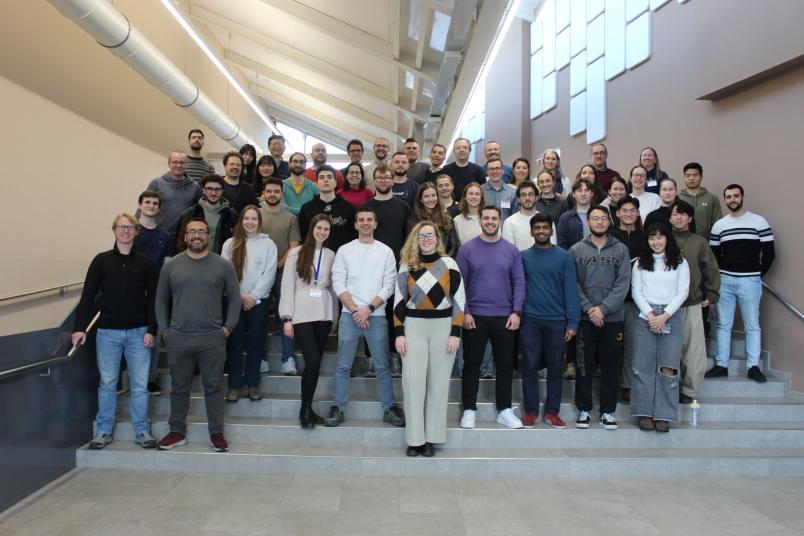
Fifty young researchers, 19 countries represented, and a technology capable of decoding the neural signals that control muscles: these are the key figures and the scientific focus of the International Winter School on High-Density Surface Electromyography, held from February 16 to 20 at Politecnico di Torino in collaboration with the University of Brescia.
The initiative brought together participants from Europe, Asia, North and South America, confirming its international scope in the field of biomedical engineering.
The school was organized by Professors Alberto Botter, Marco Gazzoni and Taian Martins, together with researcher Giacinto Luigi Cerone, from the LISiN research group (Laboratorio di Ingegneria del Sistema Neuromuscolare) of the Department of Electronics and Telecommunications-DET. The initiative was carried out in collaboration with the INCePTION group at the University of Brescia, led by Professor Francesco Negro, and with Professor Silvia Muceli from Chalmers University of Technology (Gothenburg, Sweden).
Research fellow Marta Boccardo and PhD candidates Elena Cesti and Marco Gagliardi, from the PhD program in Bioengineering and Medical-Surgical Sciences at Politecnico di Torino, also contributed to the initiative as tutors.
At the core of the Winter School was high-density surface electromyography (HD-sEMG), a non-invasive technology that records the electrical signals generated by muscles through grids of dozens of electrodes applied to the skin. This approach enables a detailed analysis of skeletal muscle activation and coordination during force production and movement.
The integration of advanced signal processing algorithms further allows access to the neural signals that control muscle activity, opening significant perspectives for the development of non-invasive neural interfaces. Applications range from basic research and the study of neuromuscular disorders to the control of prosthetic devices and clinical applications.
Throughout the week, the program covered the full methodological pathway, from biomedical instrumentation for HD-sEMG signal acquisition to advanced data processing algorithms and their applications in the evaluation of neuromuscular disorders.
The approach was strongly hands-on and multidisciplinary: theoretical lectures were complemented by practical sessions in data acquisition and analysis, during which participants directly used high-density recording systems and applied the techniques learned in real-world settings.
The final day featured lectures delivered by international experts in the field: Professor Gregory Pearcey (Memorial University of Newfoundland), Professor Eduardo Martinez-Valdes (University of Birmingham), and Dr. Hélio Cabral (Universidade Federal do Rio de Janeiro). Their talks explored the applications of HD-sEMG in the study of human motor neuron physiology and muscle neuromechanics.
The Winter School represented an important opportunity for advanced training and international networking for the new generation of researchers, further strengthening the role of biomedical engineering in the development of advanced technologies for studying the neuromuscular system.