

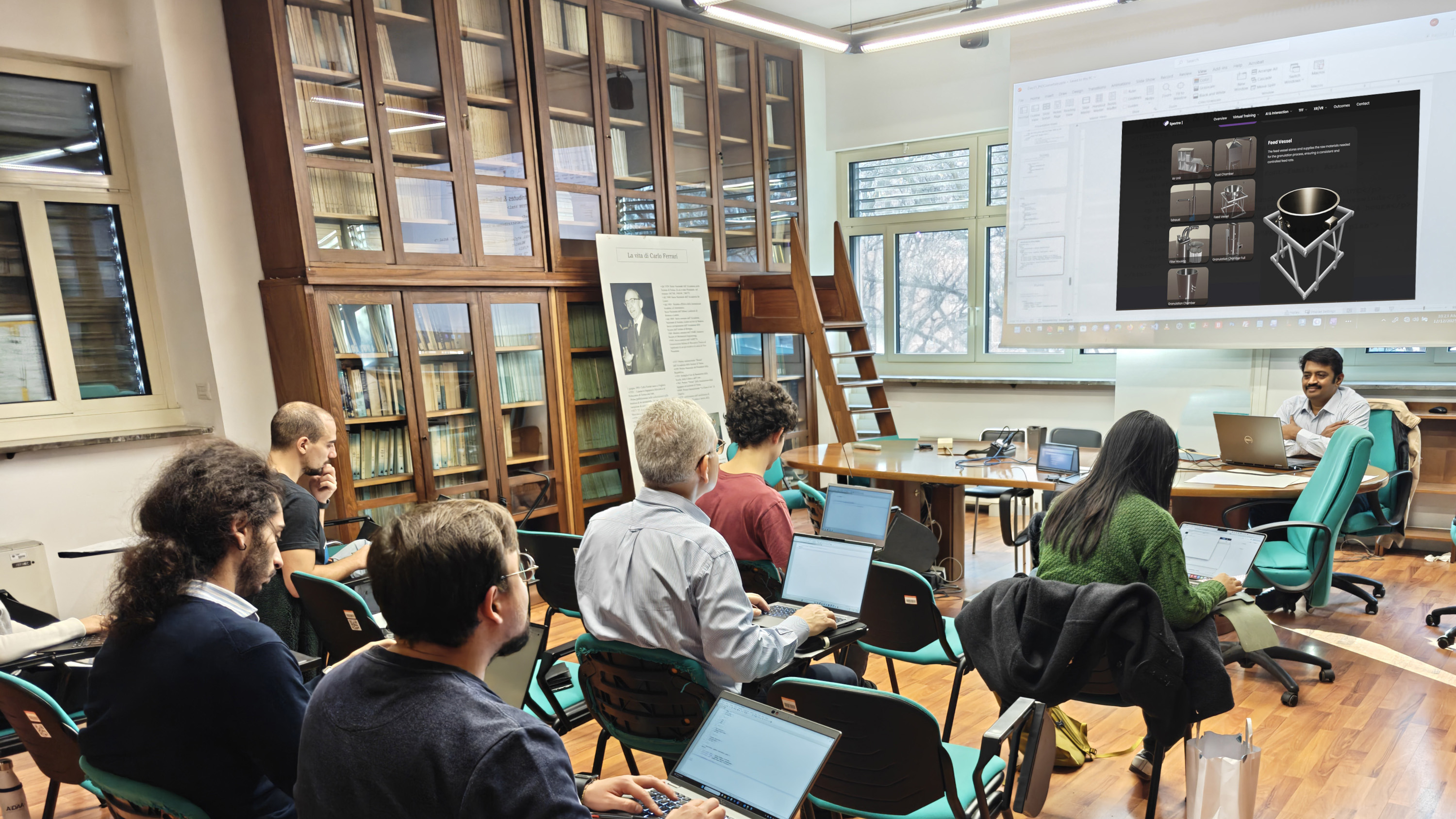
Immersive technologies for teaching aerospace engineering
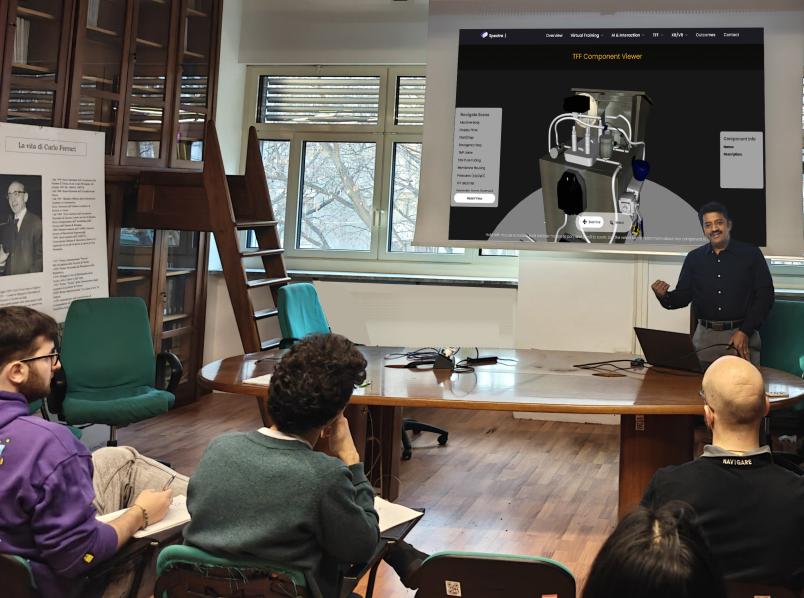
Integrating virtual and augmented reality into aerospace engineering education and research: in the past few weeks, Politecnico's Department of Mechanical and Aerospace Engineering (DIMEAS) hosted Magesh Chandramouli, Professor at Purdue University Northwest. Professor Chandramouli is a Fulbright Specialist, an expert involved in the Fulbright Programme, the most important international exchange programme in the United States. He promotes cultural dialogue between Italy and the US. Coordinated on the initiative of Politecnico's Professor Alfonso Pagani, the visit was instrumental in developing a solid collaboration between the two universities. It reinforced DIMEAS's efforts to bridge the gap between the needs of the aerospace industry and academic training, with a particular focus on virtual reality (VR) and augmented reality (AR) within the Digital Twin framework – a conceptual and technological structure for creating a dynamic virtual replica of a physical asset.
The aerospace and space sectors are currently undergoing rapid transformation, relying increasingly on immersive technologies to support training, prototyping and operational decision-making. In this context, VR and AR are becoming essential for real-time simulation and predictive modelling of complex systems, helping engineers to anticipate failures, optimise maintenance procedures and refine vehicle design before physical implementation. Their impact is particularly significant in spacecraft maintenance, in-orbit servicing and lunar vehicle operations, where immersive simulation can improve operator preparedness and reduce mission risks. Despite this industrial momentum, structured training courses for VR and AR in the aerospace sector remain limited. The Fulbright specialist's visit therefore responds to the need to accelerate this integration through a combination of teaching, curriculum development and collaborative research activities.
During his stay at Politecnico, Professor Chandramouli taught a doctoral-level course and worked closely with faculty members and graduate students to explore practical approaches for integrating immersive technologies into aerospace engineering curricula and research. The proposed programme specifically included technical discussions on immersive simulation workflows, interactive training environments, and Digital Twin-oriented methodologies, fostering interdisciplinary exchange between aerospace engineering, computer science, and human-centred design. The visit also built on previous collaboration between Professor Chandramouli and Professor Pagani as part of a grant between the National Science Foundation-NSF (USA) and the European Research Council-ERC (EU), facilitating a shared vision for the integration of VR technologies into aerospace applications, and thus increasing the impact of the visit.
“Professor Chandramouli's visit as a Fulbright Specialist was a valuable opportunity for our Department – commented Alfonso Pagani – Thanks to his contribute, we have embarked on a shared path to introduce immersive simulation technologies in a more structured way into some of the MUL2 group's space research programmes and into third-level education. This collaboration has fostered new connections and enriched the experiences of students and researchers. The Fulbright Programme remains an essential resource for fostering meaningful collaborations".
"This Fulbright visit clearly demonstrated the transformative impact of international academic exchange – added Magesh Chandramouli – Teaching a doctoral-level course and working closely with faculty and graduate students on integrating VR and AR into aerospace curricula and research has been an exceptionally rewarding experience. The Fulbright programme offers a unique platform for promoting collaboration across national borders, and Politecnico di Torino provides a highly stimulating environment where innovation, education and applied research converge. I am deeply grateful to them for their hospitality and to my College of Technology and Purdue University Northwest for their support".
A significant part of the success of the course and overall activities was also due to PhD student Dario Zamani, who worked closely with Professor Chandramouli during his time at Politecnico.
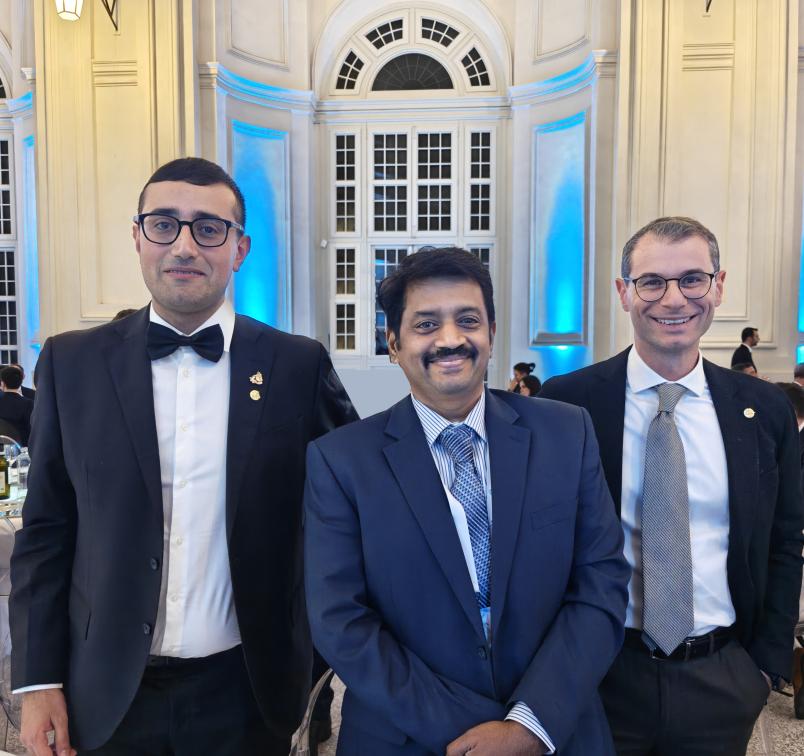
The timing of the visit further amplified its impact, as it coincided with the AIDAA-CEAS 2025 International Conference – a major event in the aerospace field that took place in Turin from 1 to 4 December – allowing Professor Chandramouli to connect with a wider network of lecturers and researchers from the aeronautical and space engineering communities, and further strengthening Politecnico's visibility on the international aerospace research scene.