

aUPaEU Mid-term Workshop on digital services and policies for institutional transformation
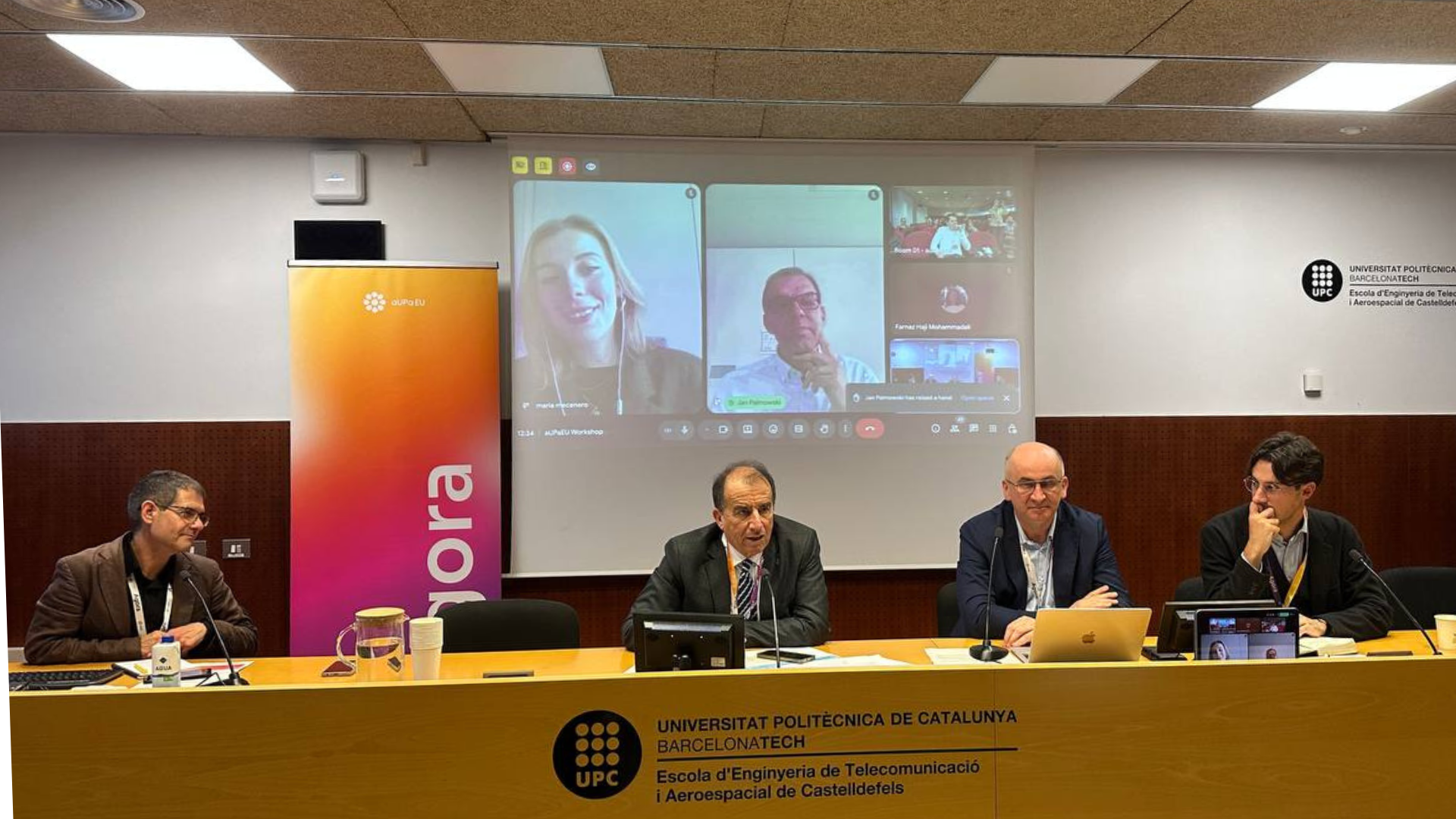
On 30 January 2026, the aUPaEU project hosted its Mid-term workshop “Stepping into Agora: a discussion with co-creators, lead users and policy experts” at the Universitat Politècnica de Catalunya in Castelldefels (Barcelona).
The event gathered 127 participants - 52 on site and 75 online - including representatives from universities, European University Alliances, and policy experts, reflecting strong interest in institutional transformation across the European Higher Education landscape.
The event focused on institutional transformation, which the aUPaEU project has been committed to supporting for three years now.
From concept to implementation: the Agora service co-creators
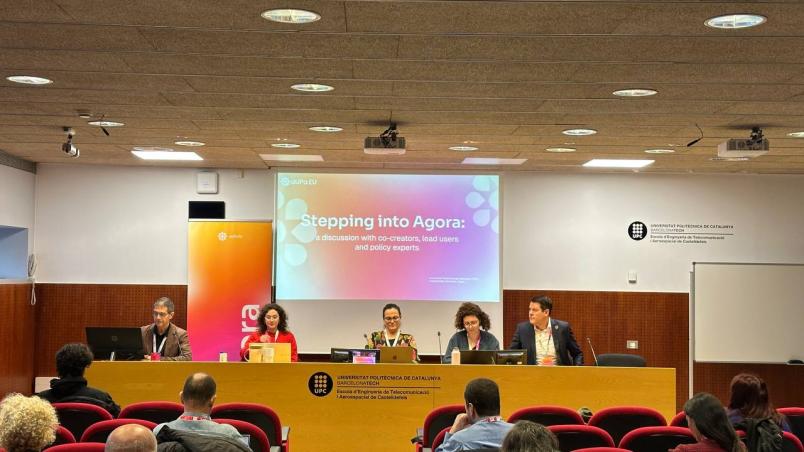
The first part of the workshop, focused on Agora (the digital platform developed by aUPaEU) and its services, which are designed to accelerate transformation. Project coordinator Jesus Alcober presented Agora as a “digital nexus”: because it provides a central hub for university alliances to fulfil all the different aspects of their mission: not only education, but also research, innovation and service to society. He also introduced the concept of a “Metagora”, as a federation of Agoras, to overcome university alliance boundaries, positioning Agora as a digital mediator.
This session importantly featured Agora service co-creators.
Amparo Zamora, from the Uninovis alliance (University of Malaga) presented the platform’s Research Portfolio service, a catalogue of the research groups that are in the alliance, where different groups can find each other, find people to collaborate with and find internships. This catalogue allows universities to harmonize and manage data across institutions, moving from fragmented spreadsheets to a common digital system. There currently is no European platform that stores information as in the research portfolio: for example, it is not possible to find out which researcher works in which research group.
Beatriz Silva and Greta Temporin, from the Unite! Widening project (Unite! alliance, ULisboa and PoliTO) showcased the Digital Gender Equality Actions Repository. Their concrete use cases illustrated how Agora services support key policy requirements, such as Gender Equality Plans (GEPs), now mandatory for participation in Horizon Europe calls. The speakers stressed the added value of these tools in helping institutions - especially in widening countries - turn guidance into context-sensitive action.
Meritxell Vinyas, from the Unite! alliance and group leader for the shared infrastructure sub-group in FOREU4ALL (UPC), provided an overview of the Research Infrastructures service she co-developed with aUPaEU since its inception. She emphasised the importance of understanding that research infrastructures are strategic assets, not just support services. The issues currently impacting Europe are not the quality of the infrastructures, but the fragmentation, duplication or even access barriers. It is in this context that the Agora service comes in, to valorise and share the resources we have.
Stefan Weidner (Otto von Guericke University Magdeburg) closed the first session by sharing the experience of his alliance, EU GREEN, in adopting Agora as a sustainable digital hub for the alliance. He described Agora as a 'translator' or mediator between different countries, systems and institutions.
Between the first and second sessions, participants enjoyed a coffee break and a poster session featuring posters from aUPaEU, as well as those from sister projects CATALISI and Accelerate Future HEI, with which aUPaEU collaborates closely.
Institutional transformation and policy perspectives: the Policy Round Table
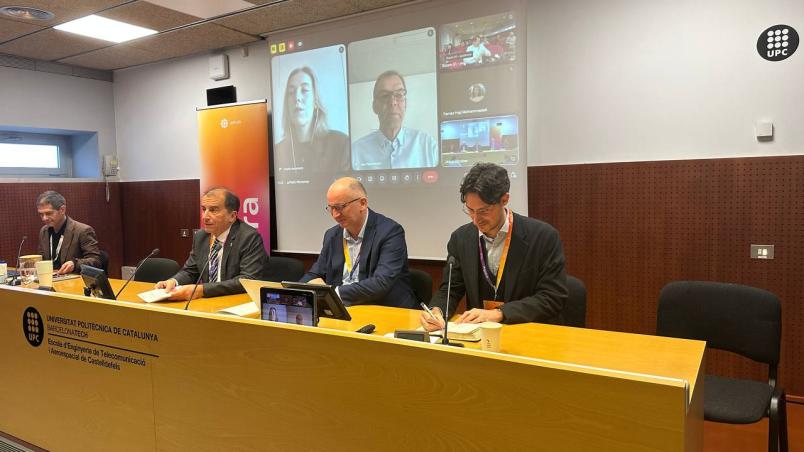
The second part of the workshop featured a Policy Round Table, moderated by Professor Roberto Zanino (Politecnico di Torino), focusing on institutional transformation within the framework of the European Research Area (ERA).
“The aUPaEU project has attracted significant interest from many different Alliances, which is really great, because the project’s original ambition was exactly to service the needs of the whole system of Higher Education Institutions in Europe”- Zanino remarked, adding that - “The governance of the institutions making up Alliances must now be involved if we want the results of this project, which is responding to real bottom-up needs, to be made relevant for the institutions diffusing through all their different layers to have a real impact. Without engagement from rectors and institutional leadership, even well-designed initiatives risk having limited impact."
Guest speakers Michał Banaszak (Vice-Rector for Digitization and Cooperation with the Economy at AMU), Mattia Bellotti (EUTOPIA’s Secretary General), Maria Mecenero (Policy Officer at DG RTD) and Jan Palmowski (The Guild’s Secretary General) addressed key elements of the 2025-2027 ERA Agenda, including competitiveness, research career attractiveness, infrastructures, capacity and Artificial Intelligence.
The speakers underlined the value of a mix of the bottom-up and top-down approaches: grounded in real institutional needs and complemented by structural policies with involvement from both upper and middle management. The discussion then shifted towards the enablers of change, such as funding opportunities for alliances and research consortia, as well as strategies for retaining and attracting excellence.