


Hydrogen to the Renewable Energy Communities: European project H2SCORE kicks off

On 11 and 12 December, the kick-off meeting of H2SCORE (Hydrogen Storage and Fuel Cells for Optimised Renewable Energy Communities) was held at Environment Park in Turin. H2SCORE is a new European project officially launched on 1 December and funded by the European Union through the Horizon Europe – Clean Hydrogen Partnership programme. Coordinated by Politecnico di Torino, under the scientific leadership of Marta Gandiglio, H2SCORE brings together 15 international partners. The total budget amounts to €6 million, of which €5 million are funded by the EU. The Politecnico di Torino project team involves researchers from the STEPS research group, including Marta Gandiglio, Paolo Marocco and Massimo Santarelli.
H2SCORE aims to demonstrate how hydrogen can be integrated into Renewable Energy Communities (RECs) to improve their flexibility, autonomy and ability to fully exploit local renewable resources. Hydrogen represents both a long-term energy storage solution, capable of compensating for the seasonal variability of renewable energy sources, and a means to provide – together with other short-term storage technologies – flexibility and balancing services to the electricity grid.
At the core of the project, an integrated system for hydrogen production, storage and use will be installed, based on two complementary technologies. On the one hand, a low-temperature system including a PEM electrolyser, metal hydride storage and PEM fuel cells; on the other hand, a high-temperature system based on an rSOC module, capable of operating both in fuel cell and electrolysis modes and also fuelled by syngas produced by a local biomass gasifier. Integration with the district heating network of Quarona will also allow the valorisation of the heat produced by the high-temperature system. One of the project’s innovations is hydrogen storage in metal hydrides, a compact and safe solution operating at low pressure, which simplifies regulatory aspects and improves acceptability in urban environments. The use of local biomass – already part of the district heating supply chain – makes the project deeply rooted in the territory and its circular economy. In addition to the fixed infrastructure, H2SCORE will also include a portable hydrogen generator to be used during events or temporary situations, as an alternative to conventional diesel generators.
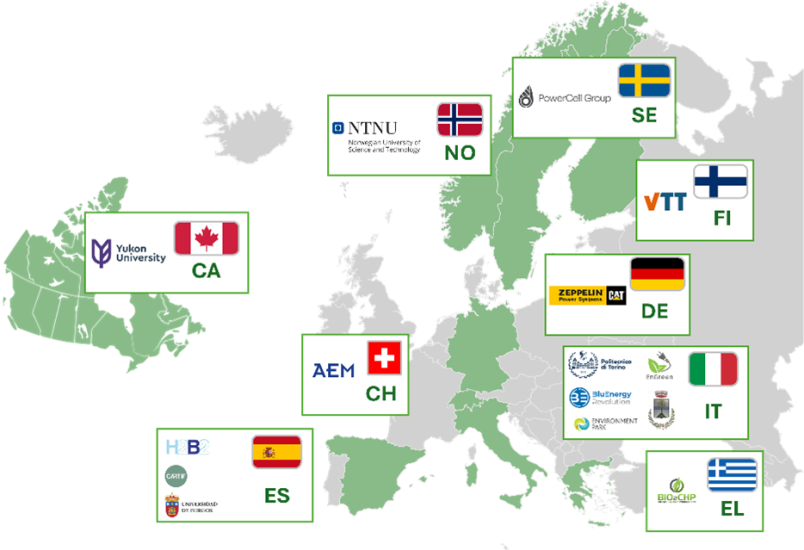
The consortium is led by Politecnico di Torino and includes among the local partners Environment Park – responsible for the portable unit, regulatory support to RECs and communication activities – and ENGREEN, which will manage the design and installation of the demonstration site and support replicability analyses in Italy. The Municipality of Quarona, in the Valsesia area, is a direct partner of the project and will host the demonstration infrastructure.
These are complemented by the project’s key technology providers: BluEnergy Revolution from Genoa for PEM electrolysers and metal hydride storage, PowerCell Sweden and Zeppelin Power Systems for PEM fuel cells, H2B2 for the rSOC system, and BIO2CHP for the biomass gasifier. The consortium also includes European academic and industrial partners dedicated to environmental assessment (VTT), safety (NTNU), replicability, and energy system modelling (Politecnico di Torino).
The project foresees a one-year demonstration campaign, during which energy performance, environmental and social benefits will be monitored, and potential pollutant emissions and hydrogen leakages will also be measured. In parallel, four replicability studies in other areas in Italy (ENGREEN), Spain (University of Burgos), Switzerland (Azienda Elettrica Massagno) and Canada (Yukon University) will assess how the model can be adapted to different geographical and regulatory contexts and help identify the role and optimal conditions that make these hydrogen technologies effective.
The choice of implementing the demonstration in Quarona confirms the role of the Piedmont region as an advanced laboratory for the energy transition, thanks to the collaboration between Politecnico di Torino, companies and local institutions.
“Hydrogen, under certain contexts and conditions, can become a key element to support complex multi-energy systems, especially where different types of local renewable sources and different final energy vectors coexist”, explains Marta Gandiglio, professor at the Department of Energy “Galileo Ferraris” (DENERG) and project coordinator for Politecnico di Torino. “We are particularly pleased that this demonstration is taking place in Piedmont, as it represents a unique platform for researchers to test and analyse innovative technologies and, at the same time, an opportunity to introduce citizens to high-efficiency, zero-emission solutions that can make a concrete contribution to the energy transition.”