

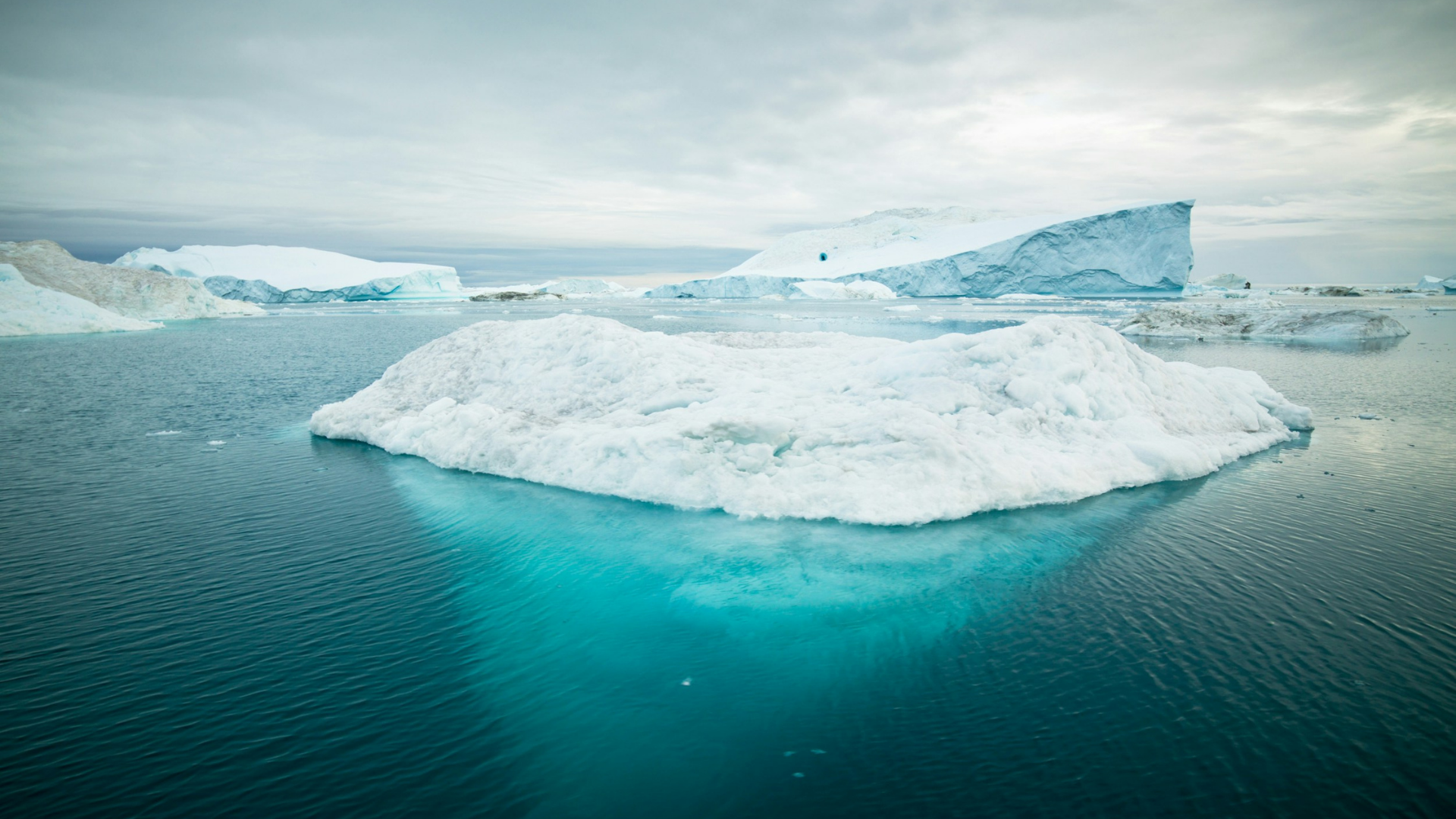
Greenland Ice melt and the future of Atlantic Ocean circulation

A new study by Politecnico, published in Science Advances – one of the leading international open-access journals in the Science family – sheds light on one of the major questions surrounding climate change: what will happen to the ocean currents that regulate Europe’s climate?
Originating from the doctoral research conducted at Politecnico by Oliver Mehling, now a postdoctoral researcher at Utrecht University, the study lists Mehling as the first author and Professor Jost von Hardenberg of Department of Environment, Land and Infrastructure Engineering-DIATI as co-author – focuses on the Atlantic Meridional Overturning Circulation (AMOC), the vast system of ocean currents that includes the Gulf Stream and plays a fundamental role in regulating Europe’s climate, helping to maintain relatively mild temperatures across the continent.
For years, scientists have debated whether global warming could push this system beyond a critical threshold, triggering a rapid and potentially irreversible weakening. In simplified models, the crossing of such a “tipping point” of the AMOC can be triggered by freshwater input into the ocean, for example from melting of the Greenland ice sheet. However, most complex climate models do not include ice sheet melt in their simulations of future climate, and this has led to concerns that they underestimate the risk of crossing a critical threshold of the AMOC.
The study’s findings alleviate some of these concerns. While the melting of the Greenland Ice Sheet is expected to contribute to a further weakening of the AMOC in the future, the researchers found no evidence of an abrupt collapse due to ice sheet melt in their climate model under a strong global warming scenario. This result does not lessen concerns about climate change, but it does provide a clearer understanding of how one of the Earth’s key climate-regulating systems may evolve.
To investigate the role of Greenland ice melt, the researchers used a state-of-the-art climate model to compare two model configurations: one including a substantial but realistic input of freshwater from the melting Greenland Ice Sheet, and another without it.
The simulations show that meltwater does indeed contribute to further weakening the AMOC, leading to an additional reduction in its strength of between 10% and 20% by the end of the 21st century. However, contrary to what has been suggested by some simplified models, this process does not take the form of a sudden system collapse. Instead, the AMOC weakening in the model occurs gradually and progressively, tracking the rise in global temperatures and the ongoing evolution of climate change.
“Climate models consistently indicate that the Atlantic circulation will weaken throughout the 21st century, even without accounting for the contribution of Greenland Ice Sheet melt – explains Oliver Mehling, first author of the study, which originated from his PhD research at Politecnico – Our results show that Greenland meltwater amplifies this process, but its impact is initially modest compared with other sources of uncertainty. In the long term, however, its role is expected to become increasingly important, particularly beyond 2100 if global warming and greenhouse gas emissions continue to rise in the absence of effective mitigation measures”.
Another significant finding of the study concerns the system’s ability to recover once the drivers of change are strongly reduced – in other words, the reversibility of the phenomenon. To investigate this aspect, the researchers simulated scenarios in which atmospheric carbon dioxide concentrations gradually decline over time. These model experiments are highly idealized because they would require unfeasibly large amounts carbon dioxide removal but nevertheless reveal a lot about the underlying dynamics. Under a reversal of carbon dioxide concentrations, the AMOC in the model strengthens again, regardless of the amount of freshwater previously added through Greenland ice melt.
This behavior suggests that the weakening of the ocean circulation observed in the simulations does not correspond to an irreversible shift. Rather, the system retains the capacity to stabilize if global warming is brought under control.
These findings, however, should not be interpreted as grounds for complacency. While Greenland melt alone does not appear sufficient to trigger an abrupt collapse of the Atlantic circulation in the future, it remains one of the main drivers of sea-level rise, with serious and potentially irreversible consequences for millions of people living in coastal regions around the world.
“The absence of evidence for an abrupt collapse does not mean that we can relax – Mehling emphasizes – Greenland ice loss will continue to contribute to sea-level rise, affecting millions of people worldwide. Moreover, there are other processes in the ocean which many climate models do not represent well, so the risk of a future AMOC disruption might still be underestimated in models.”
Although Greenland melt does not appear sufficient on its own to trigger an abrupt collapse of the Atlantic circulation, climate change continues to profoundly alter the balance of the Earth system. For this reason, the message emerging from the research is unequivocal: reducing greenhouse gas emissions remains the highest priority. Only effective mitigation efforts will be able to limit the impacts of global warming and reduce future risks to the climate, ecosystems, and human societies.